How to Write Content That Gets Cited in Google AI Overviews
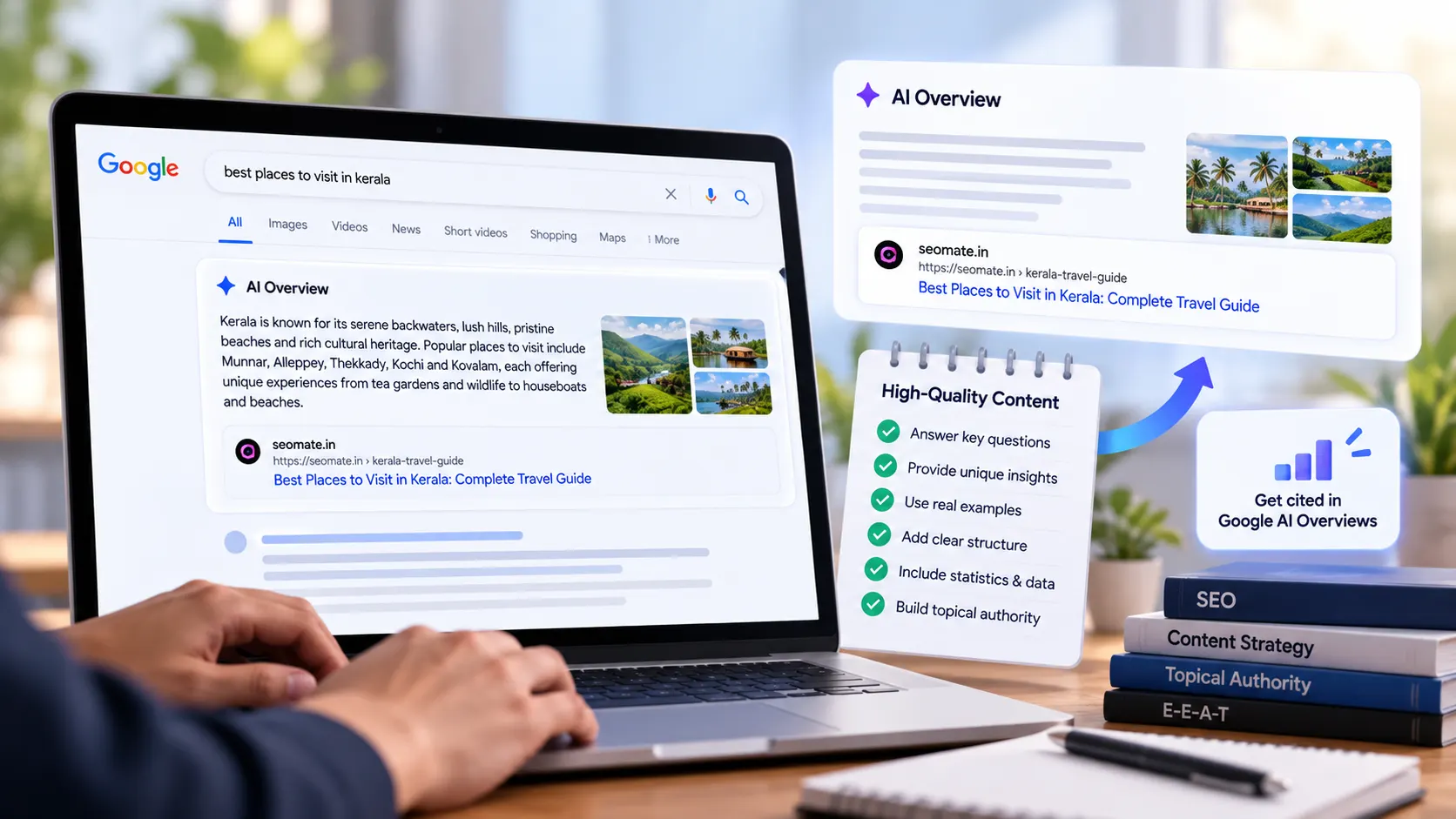
SEOmate editorial guide · Updated October 13, 2026
The short answer
You cannot guarantee that Google AI Overviews will cite a page. Google's guidance is to follow foundational SEO practices and publish helpful, reliable, people-first content with unique value. Answer the reader's main question clearly, support claims with evidence, use descriptive headings, keep technical SEO healthy and provide first-hand insight generic pages do not offer.
How AI Overviews and citations work
Google AI Overviews present an AI-generated summary with links to supporting web pages. Google says links in an AI Overview are counted in Search Console when clicked, and links in the overview are assigned the overview's position under its reporting methodology. Being eligible to appear in Search does not guarantee selection for a particular answer.
Six principles for useful, citation-worthy content
1. Answer the core question early
Lead with a concise, accurate response to the question implied by the title. Then explain reasoning, exceptions and steps. This helps readers understand the page quickly. Do not reduce the whole article to a short answer or add artificial fragments to imitate a supposed AI format.
2. Add original information, not another generic summary
Include first-hand experience, original analysis, practical examples, screenshots, tested workflows, unique data or a clear expert perspective where appropriate. Google's guidance emphasizes valuable, unique content rather than commodity pages that repeat what is already available.
3. Make important claims easy to verify
Support factual statements with primary sources, official documentation, transparent methodology or relevant data. Distinguish facts from opinion and predictions. Keep statistics current, include dates where freshness matters and correct errors promptly.
4. Use clear headings and logical structure
Organize the article around real reader questions. Use descriptive H2 and H3 headings, concise paragraphs and meaningful lists or tables when they improve comprehension. Google says there is no ideal page length or requirement to split content into tiny chunks for AI features.
5. Be precise about names and context
Use the actual product, organization, feature or metric name where relevant. Define technical terms and explain relationships. Avoid keyword stuffing and awkward repetition. Clear context helps readers and systems interpret what a claim refers to.
6. Keep technical SEO fundamentals healthy
Make the page crawlable and indexable, return a successful HTTP status, use an appropriate canonical URL, provide useful internal links and avoid blocking important content from Googlebot. Structured data can help with supported rich results when implemented correctly, but Google says special AI schema is not required for AI Overviews.
A practical article template
- Direct answer: a concise, factual response to the main question.\n2. Context: explain who the answer applies to and why it matters.\n3. Steps or criteria: give a practical process readers can follow.\n4. Evidence: add sources, original data, examples or documented experience.\n5. Limitations: explain edge cases and what is not known.\n6. FAQs: address genuine follow-up questions without repeating the article.\n7. Next step: link to a relevant tool or guide that genuinely helps.
Example: improve a weak SEO paragraph
Weak: “AI SEO is important. Optimize content for AI and use semantic keywords to rank better.”\n\nStronger: “Google does not require a special AI file or a fixed content format for AI Overviews. Start by making the page crawlable, answering the searcher's question accurately, and adding evidence or experience that improves on generic summaries. Check Google's current guidance before adopting a new AI-search tactic.”\n\nThe stronger version is specific and grounded in published guidance. Add original examples and primary-source links to make the full article more valuable.
How to measure results without guessing
Track relevant Search Console queries, pages, clicks, impressions, CTR and average position over time. Annotate major content or technical changes. Where available, review reporting for generative AI search features and assess referral analytics carefully. You can record AI citations manually or with a consistent monitoring process, but citation tools can vary and no single snapshot proves broad visibility.
AI Overview SEO mistakes to avoid
- Publishing many lightly edited AI-generated pages with little original value.\n- Adding unsupported statistics or fabricated expert quotes.\n- Stuffing the same keyword into every heading.\n- Creating llms.txt or special schema because you assume it guarantees citations.\n- Breaking content into tiny sections to satisfy a rumored AI preference.\n- Promising clients a guaranteed AI Overview placement.
A publication checklist for SEO teams
Before publishing, confirm that the article answers a real audience need, includes accurate facts and original value, cites reliable sources, uses a clear title and descriptive headings, has a sensible internal link, and is technically accessible. Review it when official guidance or underlying facts change.
Also Read: Crawled, Currently Not Indexed: What It Means and How to Fix It
Frequently asked questions
Can I guarantee an AI Overview citation?
No. Google does not provide a guaranteed placement formula. You can improve quality and accessibility, but selection depends on Google's systems and the query.
Does Google require special schema for AI Overviews?
Google says there is no special schema.org markup required for its generative AI features.
Should I write shorter articles for AI Overviews?
Not automatically. Google says there is no ideal page length. Use the length and structure needed to satisfy the reader.
Does llms.txt help Google AI Overview citations?
Google says llms.txt is not used as a special signal for Google Search, including its generative AI features.
Can AI-generated content appear in AI Overviews?
Using AI tools does not automatically disqualify content. It should be accurate, useful and add value. Scaled pages created without meaningful value can violate Google's spam policies.
Sources and further reading
- Google Search Central: generative AI search optimization guide
- Google Search Console: impressions, position and clicks
- Google Search Central: guidance on generative AI content
Consult these primary sources for current official guidance. Search features and documentation can change over time.
Put this into practice
Use the relevant SEOmate tool to support your workflow, then verify the result on your live website.
Open AI Citation Checker →